Auve Stack
Auve Stack is the proprietary AI-powered autonomous driving software developed by Auve Tech

100+

Meter  detection range

7

LiDars

12

Cameras

Auve Tech software

Self-driving shuttle MiCa with Auve Stack software allows autonomous driving in various weather and traffic conditions.
Our software is combined of multiple layers of software to insure seamless integration.

Perception

Vehicile Platform Integration

Safety

Remote Supervision

Auve Stack 2.0

Object Detection

Uses multi-sensor fusion for accurately distinguishing between pedestrians, cyclists, and vehicles.

Field of View

Sensors creating a 360degree view of MiCa's surroundings

Dynamic Reaction

Enables advanced maneuvers like automated overtaking and safe obstacle avoidance

Predictive Navigation

Uses machine learning and AI to anticipate unexpected obstacles and smoothly navigate complex scenarios.
Auve stack layered system, consists of core autonomy, vehicle platform integration, perception, remote monitiring and safety.
Every component is designed to work seamlessly together, ensuring performance you can trust in real-world conditions.
Executes decisions with drive-by-wire precision
Control & Safety
Optimizes safe and efficient route execution
Planning
Anticipates dynamic road behavior using AI vision
Prediction
Comprehensive environmental awareness through sensor fusion
Perception
LIDAR, cameras, GPS and IMU
Sensors

Sensors & Perception

Shuttle View

The shuttle's advanced perception system combines 7 LiDAR sensors and 12 cameras (10 exterior and 2 interior) to maintain a continuous 360-degree view of its surroundings.

Using AI-powered sensor fusion, the system integrates data from LiDAR, cameras, GPS, and IMU sensors to create a unified, real-time understanding of the vehicle's environment. This enables high-precision 3D mapping, object detection, road feature recognition, and accurate vehicle localization, supporting safe, reliable, and informed autonomous operation.

Prediction & Planning

Uses AI models to predict road user intent and movement, identify potential risks, and evaluate traffic conditions, obstacles, and operational constraints. Generates real-time trajectories and speed profiles, which are executed through drive-by-wire control, translating decisions into precise steering, acceleration, and braking commands for safe, smooth, and reliable autonomous operation.

MiCa
Capabilities

Detection

  • Detects obstacles as small as 15 cm in height and width.
  • Gradually slows down and stops at a safe distance when encountering obstacles. Automatically resumes its journey once the path is clear.
  • For sudden obstacles, applies a controlled stop with higher deceleration.

Overtaking

  • MiCa's obstacle avoidance maneuvers stay within its designated lane.
  • Maintains a safe minimum distance of 50 cm from the object during maneuvers.
  • Ensures a smooth and controlled path while avoiding obstacles.

Intersections

  • Automates intersections using stop lines with operator-issued "GO" commands for improved safety and traffic flow.
  • Detection zones can halt the vehicle when obstacles are detected, prioritizing safety, with ongoing refinement for challenging environments.

Detection

Vehicle detects obstacle ahead and reacts accordingly

Overtaking

MiCa finds if the path is safe, it can overtake

Intersection

Shuttle yields or proceeds based on traffic priority at intersections

Control & Safety

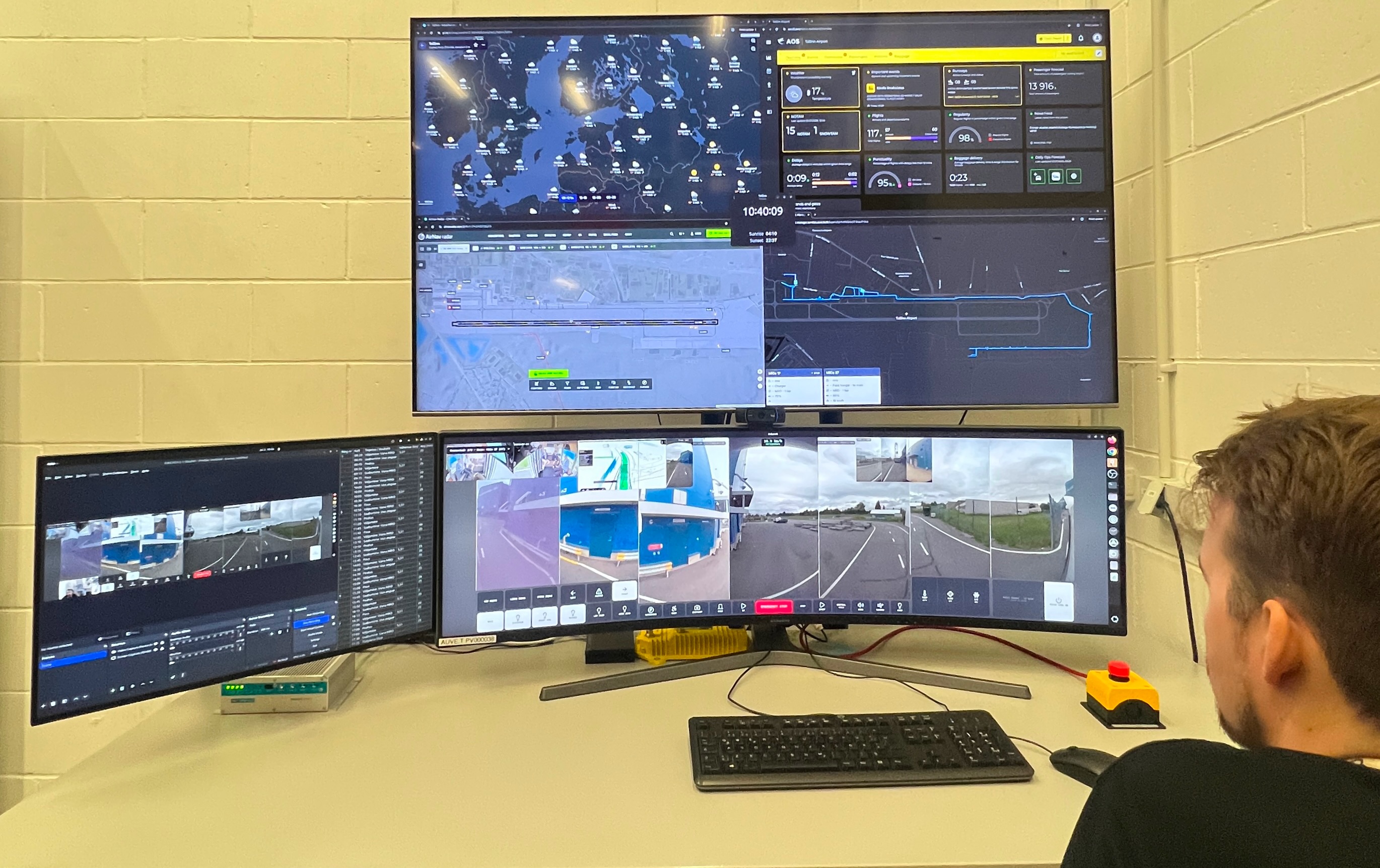
Remote Supervision

Biggest expense in transport is human workforce, with a single remote supervisor overseeing multiple fleet, we change that.
Single operator can oversee multiple shuttles simultaneously from a control center.

MiCa perceives its surroundings, navigates routes, and makes driving decisions independently. Remote supervisors intervene only when necessary by issuing commands to assist the shuttle in complex situations.
Remote supervisors receive live camera and LiDAR feeds, vehicle status information and operational data. In addition to monitoring the vehicle's external environment, supervisors also have visibility into the shuttle interior. This allows them to assess passenger conditions and monitor onboard systems and features such as seatbelts, climate control, and other operational functions, helping ensure a safe and comfortable passenger experience.
By enabling one operator to oversee multiple vehicles, Remote Supervision improves operational efficiency while maintaining high safety standards. Combining autonomous decision-making with human oversight creates a reliable, practical, and scalable solution.

Safety Testing

To make sure that MiCa is as safe as possible. Multiple tests are carried out to ensure that.

Simulation testing

Testing vehicle behavior in virtual environments to evaluate scenarios, edge cases, and system performance safely and efficiently.

Track testing

Testing autonomous functions in a controlled environment to verify safety, reliability, and operational performance.

On-road testing

Testing in real-world operating conditions to validate system readiness, safety, and regulatory compliance before deployment.

Ready to automate your
mobility?

Whether you're interested in deploying autonomous shuttles, exploring partnership opportunities, or learning more about our technology, our team is here to help.

GENERAL INQUIRIES
hello@auve.tech
Thank you! Your submission has been received!
Oops! Something went wrong while submitting the form.